Villa Espada Blog & Guide
Cap Cana is the gated, golf-and-marina corner of the Dominican Republic that most people mean when they say they want Punta Cana “but quieter and more private.” This is the practical, on-the-ground guide: what it actually is, the golf and the beaches, where to stay, when to go, and how to sidestep the one thing that catches visitors out.
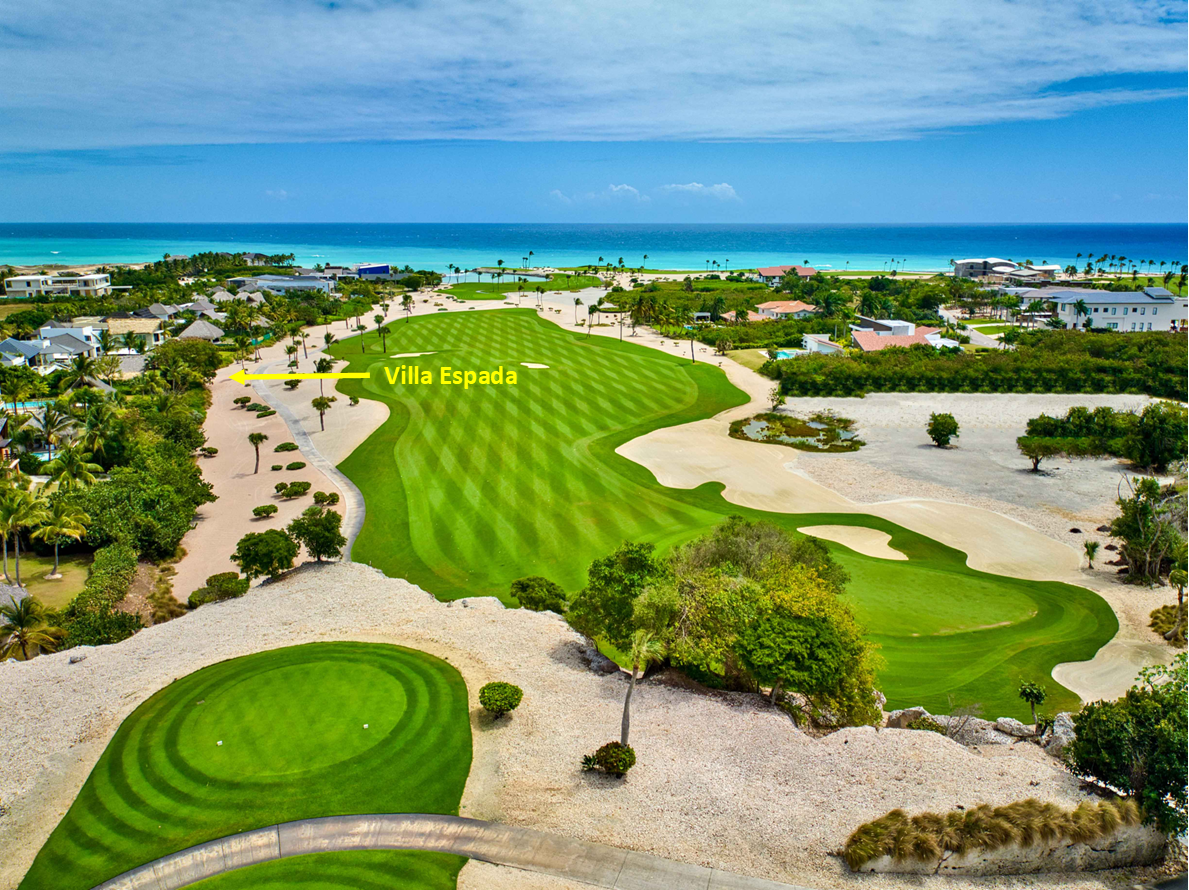
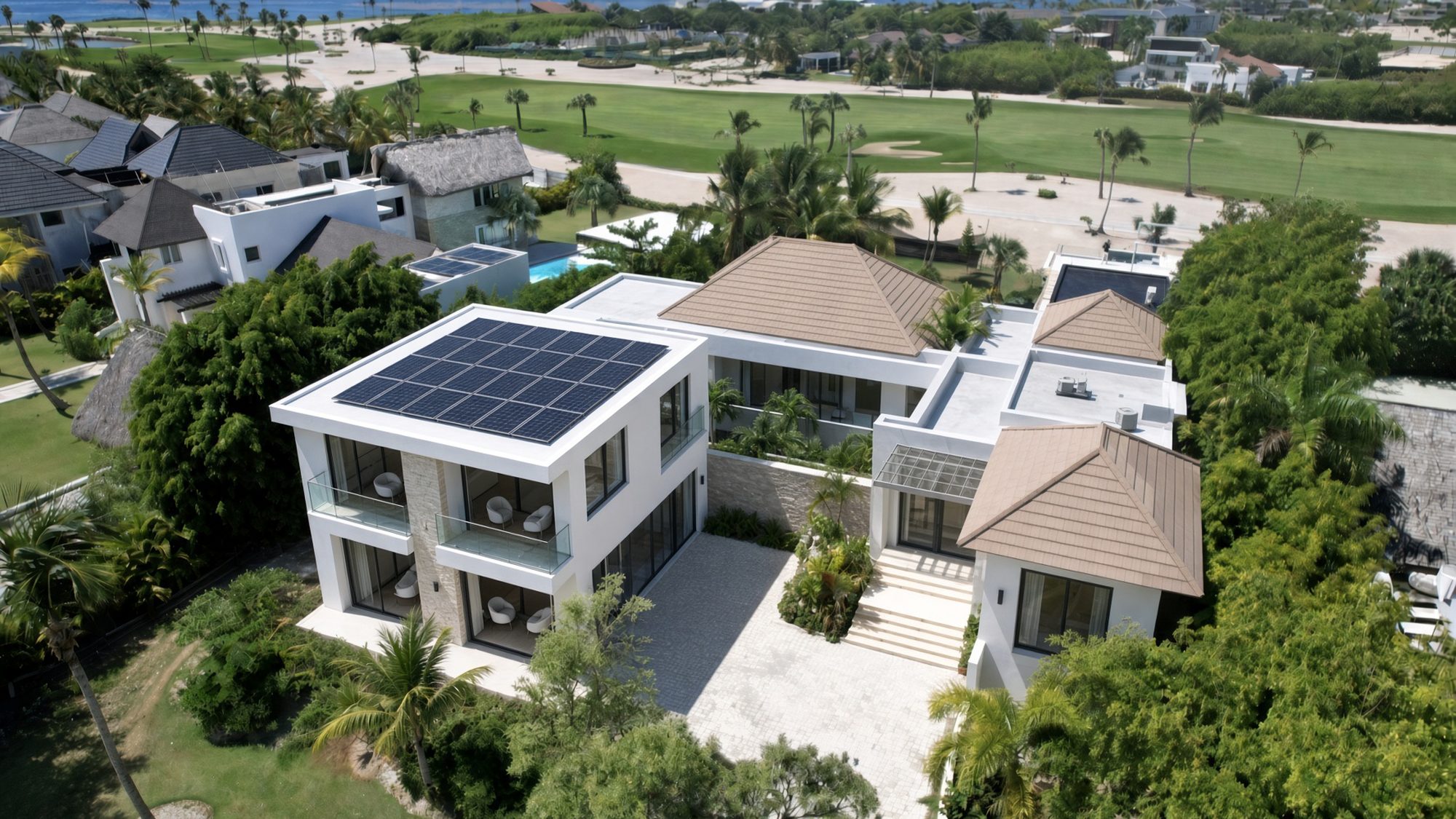
Guests at Villa Espada — a 6- or 8-bedroom private estate on Fairway 5 of Punta Espada Golf Course — reach everything in this guide by golf cart, arranged through their own butler. It is the only private rental estate in Cap Cana with a direct fairway address.
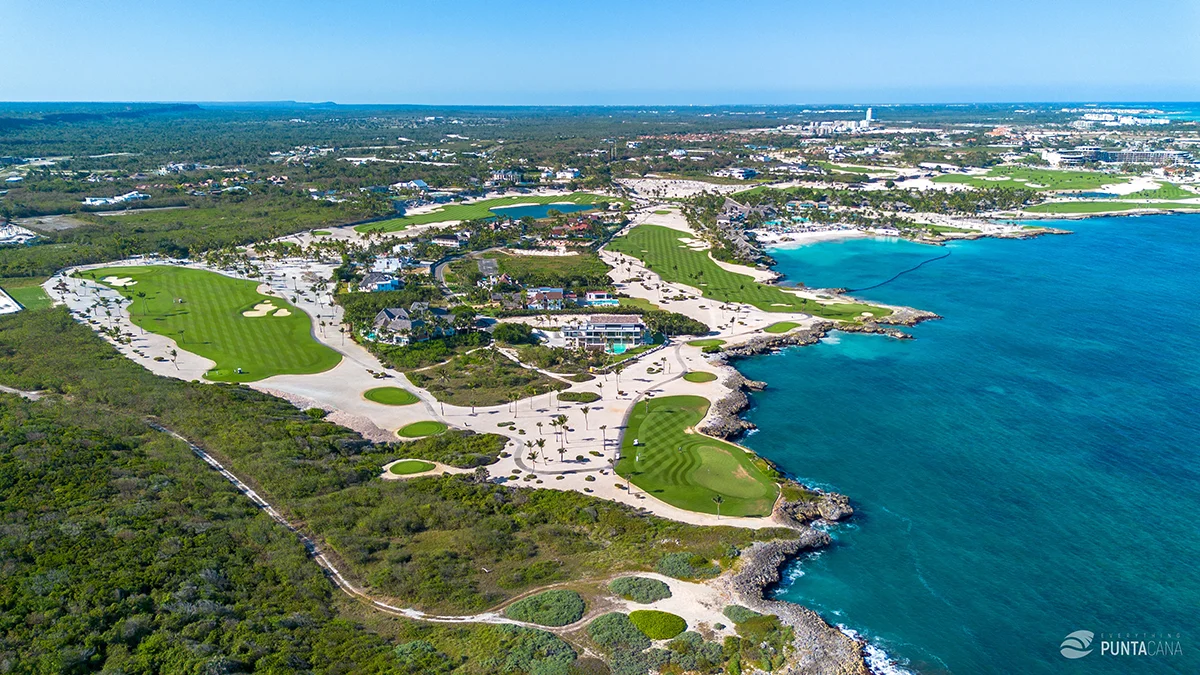
Check availability →Cap Cana is a private, gated community of roughly 30,000 acres on the eastern tip of the Dominican Republic, about 20 minutes south of Punta Cana International Airport (PUJ). Think of it less as a single resort and more as a small, carefully controlled town built for leisure: two championship golf courses, a deep-water marina, several miles of protected coastline, luxury hotels, private villas, restaurants, and adventure parks, all behind 24-hour security with no through-traffic, no roadside vendors, and no public access roads.
That gated setup is the whole appeal. Greater Punta Cana and neighboring Bavaro are lively, dense, and lined with big all-inclusive resorts and public beach. Cap Cana is the opposite: spacious, quiet, and manicured, the kind of place where the loudest sound on the fairway is the sea. If you have been to Punta Cana before and found it too busy, Cap Cana is usually the answer to what you were missing.
The names get used interchangeably, so it helps to keep them straight. Punta Cana is the broad region and the airport code. Bavaro is the busy resort-and-beach strip just north of the airport, where most of the well-known all-inclusives sit shoulder to shoulder. Cap Cana is the gated luxury enclave to the south, a 15- to 20-minute drive from the terminal. All three share the same climate and the same turquoise water; they differ almost entirely in density and privacy. Cap Cana trades nightlife and walk-everywhere convenience for calm, security, and space.
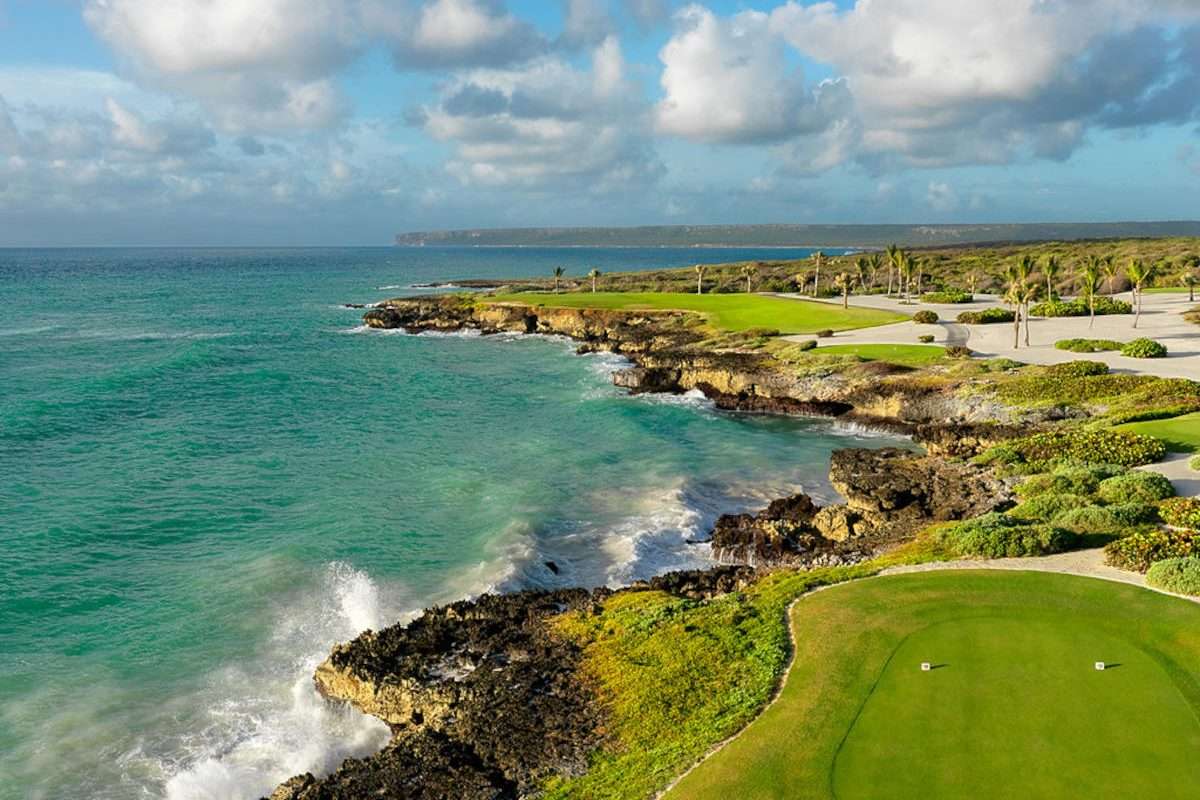
Golf is the reason a lot of people come to Cap Cana in the first place, and it earns the reputation. Punta Espada, a Jack Nicklaus Signature design opened in 2006, is ranked the number-one golf course in the Caribbean and Mexico by GolfWeek for eight consecutive years and sits inside Golf Digest’s world top 100. Eight holes play directly along the Caribbean Sea; the signature 13th is a roughly 250-yard par-3 carried over an inlet of open ocean. The course hosted the PGA Tour Champions’ Cap Cana Championship from 2008 to 2010, with Fred Couples winning the 2010 finale.
Las Iguanas, Cap Cana’s second Nicklaus Signature course, sits about two minutes away by golf cart and offers a very different round: the back nine open now, including the oceanside holes, with ten inland lakes woven through tropical terrain in the full design. Between the two you have two Nicklaus courses without ever leaving the community. And for a bigger day, the legendary Pete Dye courses at Casa de Campo — Teeth of the Dog, Dye Fore, and The Links — are about 90 minutes west and playable by villa guests. In all, roughly 17 courses lie within a two-hour drive, with Punta Espada consistently topping the list.
One important note on cost: published guest green fees at Punta Espada are among the highest in the region. Guests who rent Villa Espada book their Punta Espada tee times through the villa and receive the member-guest discounted rate, a reduced green fee available only to villa renters that saves roughly $200 per golfer, per round. Over a four-round trip for a foursome, that difference adds up quickly. (Las Iguanas is played at regular rates.)
Juanillo Beach is Cap Cana’s headline stretch and a genuine contender for the best beach in the Dominican Republic: a wide crescent of soft, pale sand and calm, clear water in a sheltered cove, with beach clubs, loungers, and restaurants along the back. Caleton Beach, home to the Eden Roc beach club, is the more intimate, boutique option on the same protected coastline. Because both sit inside the gates, they stay clean, quiet, and serviced in a way public regional beaches often do not.
Here is the honest part most guides skip: like the entire eastern Dominican coast, Cap Cana can see sargassum seaweed, the brown floating algae that drifts in from the Atlantic. It is most likely from about June through August, tends to be lightest from late October through January, and — frustratingly — arrives in unpredictable batches rather than on a schedule. Cap Cana’s sheltered, west-facing coves are generally better protected than exposed beaches farther north, and the community runs active cleanup, but no beach in the region is completely immune. If pristine water is your top priority, aim for the late-fall-to-winter window.
Cap Cana Marina is one of the Caribbean’s premier harbors, built to host superyachts and ringed by restaurants, cafes, and shops. It is also the launch point for some of the best deep-sea fishing in the hemisphere: the waters off Cap Cana are a renowned billfish ground, and blue marlin, white marlin, mahi-mahi, and wahoo are all realistic catches depending on season. The marina hosts international billfish tournaments, and a half- or full-day charter is one of the easiest excellent days out to arrange — for Villa Espada guests, the butler books it directly, a short cart or car ride from the villa.
When you want a break from the beach and the fairway, Scape Park is Cap Cana’s eco-adventure complex. Its centerpiece is Hoyo Azul, a stunning natural cenote — a deep, sapphire-blue freshwater pool at the base of a limestone cliff that you can swim in. The park also runs zip-line circuits, the Iguabonita cave with its Taino petroglyphs, cultural and animal encounters, and guided trails. It is well-managed and genuinely family-friendly, which makes it the standard recommendation for a non-golf day with a mixed group.
For a gated community, Cap Cana punches well above its weight on food. The St. Regis fields nine dining venues, several helmed by name chefs; Eden Roc’s restaurants (Mediterraneo, La Palapa, and BLUE Grill among them) are a draw in their own right; and the marina and Juanillo add a cluster of independent waterfront restaurants covering everything from ceviche to wood-fired steaks. It is easily enough variety for a week without repeating yourself.
The counterpoint, if you are in a villa, is that the best table is often your own. A private chef who shops that morning and cooks to your group’s requests — billed at grocery cost plus a service charge rather than restaurant markup — changes how a trip feels, especially for families with different schedules and young kids. Most villa groups do a mix: chef-cooked breakfasts and a few dinners in, with marquee restaurant nights out.
Cap Cana’s lodging splits into three broad camps: intimate luxury hotels, large all-inclusive resorts, and private villas. Here is the current lay of the land.
| Property | Style | Best for |
|---|---|---|
| Eden Roc Cap Cana | Boutique Relais & Châteaux, ~68 suites & villas | Couples wanting design-led intimacy |
| The St. Regis Cap Cana | 200-room luxury hotel, nine dining venues (opened 2025) | Full-service resort polish |
| Sanctuary Cap Cana | All-inclusive, Luxury Collection, colonial-castle design | All-inclusive with character |
| Hyatt Ziva / Zilara Cap Cana | All-inclusive pair — Ziva family, Zilara adults-only; Canopolis water park | Families and adults-only AI |
| Secrets Cap Cana | Adults-only all-inclusive on Juanillo Beach | Adults-only beachfront |
| Dreams Cap Cana | Family all-inclusive, ~519 rooms | Larger family AI |
| Villa Espada (private villa) | 6- or 8-bedroom staffed estate on the Punta Espada fairway, sleeps up to 22 | Groups, families, golf trips |
The hotels are excellent, and for two people they are often the simplest choice. But for a group — a family reunion, a golf foursome or two, a milestone celebration — a private villa tends to win on both privacy and math. At Villa Espada, one nightly rate covers up to 22 guests along with a private chef, butler, daily housekeeping, private airport transfers, and two six-person golf carts, which spreads across the group in a way a block of hotel rooms cannot. You can see the full villa-versus-hotel cost breakdown here.
You fly into Punta Cana International Airport (PUJ), one of the most-connected airports in the Caribbean, with nonstop service from dozens of US and Canadian cities. The gate of Cap Cana is only about 15 to 20 minutes south of the terminal, and the villa itself is roughly 25 to 35 minutes door-to-door. Approximate nonstop flight times, which vary by carrier and season:
| From | Approx. nonstop time to PUJ |
|---|---|
| Miami | ~2 hours |
| Atlanta | ~3.5 hours |
| New York (JFK/EWR) | ~4 hours |
| Boston | ~4 hours |
| Chicago | ~4.5 hours |
| Toronto | ~4.5 hours |
Because the Dominican Republic sits on Atlantic Standard Time and does not observe daylight saving, jet lag is minimal for the US East Coast — the DR is just one hour ahead in winter and the same time in summer. Villa Espada includes private airport transfer in both directions, so a driver meets you at arrivals and the trip is genuinely door-to-door.
Cap Cana is warm year-round, generally 78–90°F (25–32°C). The trade-offs by season come down to weather, water clarity, crowds, and price.
| Window | Weather | Seaweed odds | Crowds & rates |
|---|---|---|---|
| Dec–Apr (dry / peak) | Warm, low humidity, best golf | Low, best late Oct–Jan | Busiest, highest rates |
| May & Nov (shoulder) | Warm, occasional showers | Variable | Quieter, better value |
| Jun–Oct (low) | Hot, humid, brief afternoon rain | Highest Jun–Aug | Fewest crowds, lowest rates |
The dry season from December to April is the classic choice and lines up with northern winter — the core “escape the cold” window — but it is also the priciest and requires booking holidays and Semana Santa many months ahead. The low season trades some humidity and the odd afternoon shower for real value, thinner crowds, and, importantly, the same excellent golf conditions. Hurricane season officially spans June to November, though the eastern Dominican Republic is statistically less exposed than much of the Caribbean.
Yes, if what you want is a calm, gated, resort-grade slice of the Dominican Republic rather than the busy hotel strip of Bavaro. Cap Cana is a private 30,000-acre community with its own beaches, two Jack Nicklaus golf courses, a superyacht marina, and adventure parks, all inside 24-hour security with no through-traffic or vendors. It is quieter and more polished than Punta Cana proper, which is exactly the point for travelers who value privacy and space.
Punta Cana is the broad region on the eastern tip of the Dominican Republic and the name of the airport (PUJ). Cap Cana is a specific gated luxury enclave inside that region, about 20 minutes south of the airport. Everything in Cap Cana, from the golf to the marina, is private and purpose-built, whereas greater Punta Cana and neighboring Bavaro are a denser mix of large all-inclusive resorts and public beach.
Juanillo Beach is Cap Cana's headline beach, a wide crescent of pale sand and calm, clear turquoise water in a sheltered cove. Caleton Beach, home to the Eden Roc beach club, is the more intimate, boutique option on the same protected coastline. Both sit inside the gates, so they stay clean, quiet, and serviced in a way public Punta Cana beaches often do not.
The dry season from December through April is the classic window, with warm days, low humidity, and prime golf, though it is also the busiest and most expensive. For clear water specifically, late October through January tends to have the best odds of seaweed-free beaches. Sargassum seaweed is most likely from about June through August, though it arrives unpredictably. Cap Cana's sheltered coves are generally better protected than exposed east-facing beaches, but no beach in the region is immune.
Not really. Cap Cana is spread out, but most visitors get around by golf cart, resort shuttle, or a quick taxi rather than a rental car, and the gated roads make it easy. Guests at Villa Espada have two six-person golf carts included, which put the beaches, golf, marina, and restaurants within a few minutes without ever needing to drive off-property.
For couples and small parties who want restaurant variety and full hotel service, a resort like Eden Roc or the St. Regis is a natural fit. For families, golf groups, and multi-generational trips, a private staffed villa usually wins on both space and cost per person, because a single nightly rate covers the whole group along with a private chef, butler, daily housekeeping, airport transfers, and golf carts. Villa Espada is that villa option, sitting directly on the Punta Espada fairway.
Villa Espada is Cap Cana’s premier private villa — 6 or 8 bedrooms, sleeps up to 22, full staff, the member-guest discounted golf rate, and two golf carts included. We respond to every inquiry within 2 hours.
Inquire & book