Villa Espada · Expert Comparisons
Cap Cana and Casa de Campo are the two names that come up again and again when groups plan a high-end golf or villa trip to the Dominican Republic. Neither is "better" in absolute terms — the right choice depends almost entirely on what your group actually wants from the trip. Here is the honest, point-by-point breakdown.
Cap Cana, near Punta Cana International Airport, is a newer 30,000-acre gated development built around Punta Espada Golf Course — Golfweek's #1-ranked course in the Caribbean and Mexico for eight consecutive years — along with Juanillo Beach, a marina, and a growing list of resorts and private villas. Casa de Campo, near La Romana, is the older, more established 7,000-acre resort built around the legendary Teeth of the Dog course, with its own villas, marina, and an all-inclusive resort model that has been running for decades.
These are the two destinations in the country that consistently appear on global rankings, attract the same type of traveler — groups looking for private villas, serious golf, and a gated, secure environment — and sit close enough that some golf itineraries actually combine both. But similar reputations don't mean identical experiences. The two places were built at different times, for slightly different priorities, and that shows up in everything from how you get there to what your evenings look like.
| Category | Cap Cana | Casa de Campo |
|---|---|---|
| Primary golf course | Punta Espada (Jack Nicklaus, 2006) | Teeth of the Dog (Pete Dye, 1971) |
| Golf ranking | Golfweek #1 in the Caribbean & Mexico for eight consecutive years | #1 in the Caribbean (Top 100 Golf Courses); world top 50–100 |
| On-site courses | Punta Espada is the flagship; more Nicklaus golf nearby in Cap Cana | Three on property: Teeth of the Dog, Dye Fore (27 holes), The Links |
| Closest airport | Punta Cana International (PUJ), ~15–20 min | La Romana International (LRM), ~10 min; PUJ ~75–90 min |
| Development size | Approximately 30,000 acres | Approximately 7,000 acres |
| Accommodation | Resort hotels (St. Regis and others) plus private villas | Resort rooms plus traditional luxury villas, many with private pools |
| Beach | Juanillo Beach, among the best in the region | Minitas Beach, a smaller resort beach |
| Marina | Cap Cana Marina, deep-sea fishing | Casa de Campo Marina with Marina Village dining and shopping |
| Waterpark | Cap Cana Waterpark | Not a core feature |
| Adventure / eco | Scape Park | Equestrian center, shooting sports, polo |
| Meal structure | Villas typically include private chef service; resorts a la carte | Strong all-inclusive tradition across the resort |
| Overall feel | Newer, more polished, beach-and-golf energy | Older, more "estate" old-money Caribbean character |
This is usually the deciding factor for golf-focused groups, so it deserves real depth.
Designed by Jack Nicklaus and opened in 2006, Punta Espada has long held Golfweek's #1 ranking for the Caribbean and Mexico and has also appeared on Golf Digest's list of the World's 100 Greatest Courses. Eight of its eighteen holes play directly along or over the Caribbean Sea, and the routing was built specifically to maximize ocean exposure. Its signature 13th — a roughly 250-yard par-3 played across the Caribbean — is one of the most photographed holes in the region. Our hole-by-hole guide to Punta Espada covers the entire round.
Designed by Pete Dye and opened in 1971, Teeth of the Dog is the older sibling in this comparison, and in golf circles "older" here means "legendary." Seven holes play directly along the Caribbean, hand-carved from coral rock. It is regularly ranked among the world's top courses, and many serious golfers consider it the single most important course in Caribbean history. Casa de Campo also has two more courses on property: Dye Fore, a dramatic 27-hole layout perched up to 300 feet above the Chavón River, and The Links, a more traditional layout.
If your priority is tournament pedigree and a sense of golf history, Teeth of the Dog has the edge, and having three courses on one property means a golf-only trip can stay entirely within Casa de Campo for several rounds. If your priority is a single, modern, consistently top-ranked course paired with a beach that is arguably better than anything at Casa de Campo, plus newer infrastructure across the wider development, Punta Espada and Cap Cana take it. Many serious golf travelers don't choose at all — combined itineraries often pair a few days at each so groups play both courses on one trip.
Cap Cana sits close to Punta Cana International Airport (PUJ), one of the busiest and most internationally connected airports in the Caribbean, with direct flights from a large number of North American and European cities. From touchdown to your villa is typically 15 to 20 minutes.
Casa de Campo is closer to La Romana International Airport (LRM), which has fewer direct routes than PUJ. Many travelers fly into PUJ anyway and then take a 75 to 90 minute transfer, because LRM's flight options are more limited. Casa de Campo also has a private airstrip that receives charter flights. Practical takeaway: if anyone in your party is sensitive to long transfers after a flight, Cap Cana's proximity to PUJ is a tangible advantage from the moment you land.
Casa de Campo built its reputation on a traditional resort structure — hundreds of hotel rooms plus a long-established collection of private villas, many along the coast with their own pools. The all-inclusive package culture here is strong and well-developed. Cap Cana is younger, and its villa inventory tends to be newer construction with more modern interiors and direct positioning on or near Punta Espada's fairways. The St. Regis anchors the resort-hotel side, while the villa market has grown rapidly around the golf course and Juanillo Beach.
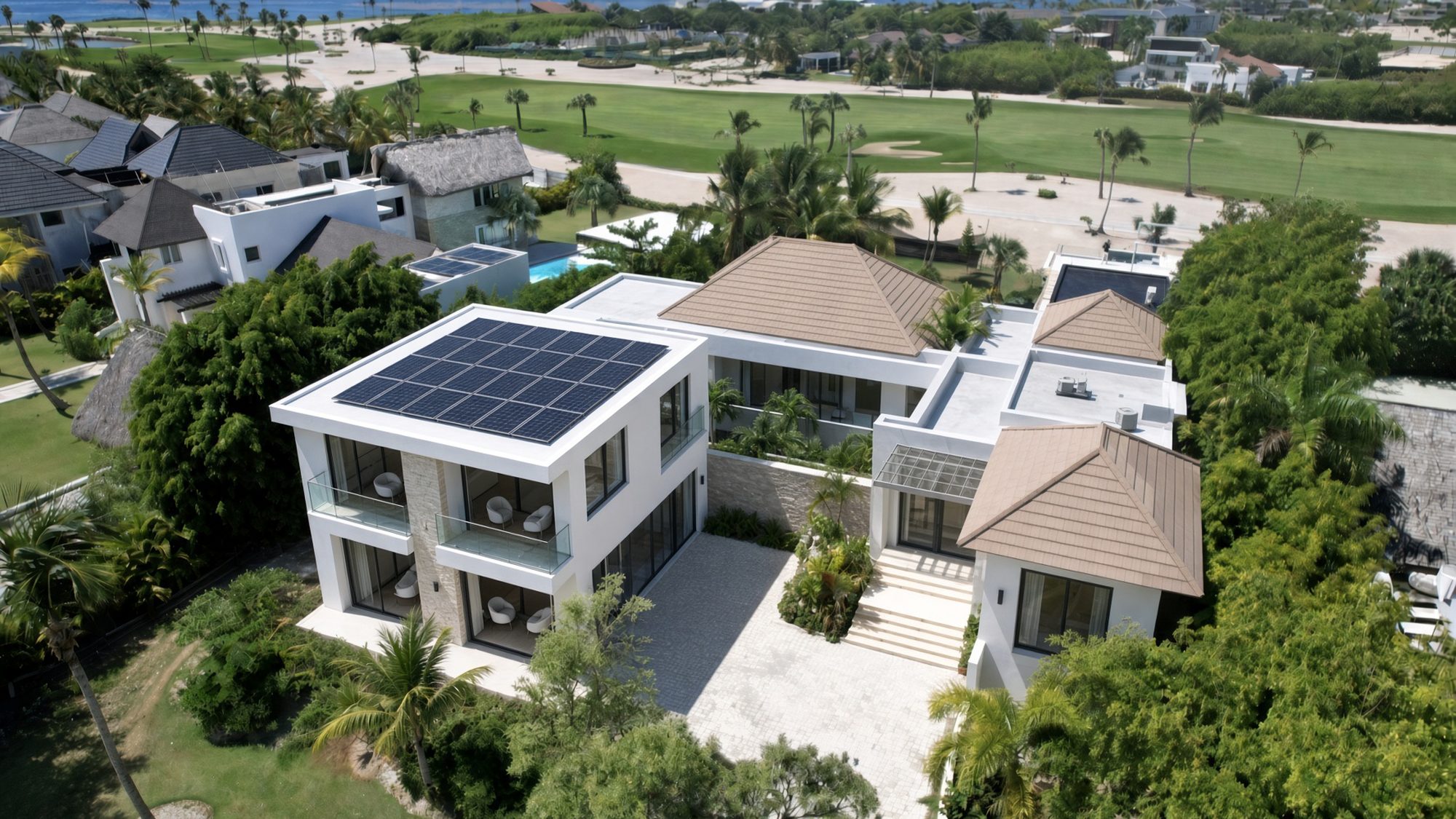
Villa Espada is a 6- or 8-bedroom estate positioned directly on Fairway 5 of Punta Espada, accommodating up to 22 guests with a private chef, full butler service, two included 6-person golf carts, member-guest discounted-rate tee times at Punta Espada, and private airport transfers. For a large group prioritizing golf, an on-course villa where the first tee is a 3 to 5 minute cart ride from the front door is exactly the kind of arrangement Cap Cana's newer inventory is increasingly built around.
6 or 8 bedrooms · Up to 22 guests · Fairway 5 · Private chef · Butler · Two 6-person golf carts · Punta Espada member-guest discounted rates · Airport transfers
Check AvailabilityCap Cana's standout feature outside golf is Juanillo Beach, consistently rated among the best beaches in the Dominican Republic for its calm, clear water and soft sand. The development also includes Scape Park for zip-lining and cave exploration, a marina for deep-sea fishing, and El Dorado Water Park, which adds a family-friendly element. For a fuller picture, see our Cap Cana guide. Casa de Campo's non-golf strengths lean toward equestrian sports, a shooting range, polo, and the Marina Village dining and nightlife district. Minitas Beach is pleasant but smaller and more of a resort beach than a destination in its own right.
There is no universal right answer, but the decision usually comes down to a few honest questions:
For many groups staying a full week, the answer isn't "instead of" but "as well as" — a combined itinerary lets you experience both courses, both beach environments, and both villa styles without compromising on either.
It depends on priorities. Casa de Campo offers three courses including the historically significant Teeth of the Dog, regularly ranked among the world's top courses. Cap Cana's Punta Espada is ranked Golfweek's #1 course in the Caribbean and Mexico for eight consecutive years. Groups wanting multiple rounds across different courses often prefer Casa de Campo; groups happy with one consistently top-ranked course paired with a stronger beach often prefer Cap Cana.
Cap Cana is closer to Punta Cana International (PUJ), typically a 15 to 20 minute transfer. Casa de Campo is closer to La Romana International (LRM), about 10 minutes, but LRM has fewer direct international flights, so many travelers fly into PUJ and take a 75 to 90 minute transfer instead.
Cap Cana's Juanillo Beach is widely considered one of the best beaches in the Dominican Republic. Casa de Campo's Minitas Beach is a pleasant resort beach but generally smaller and less of a standalone attraction.
Yes. Because both are within a few hours of each other by road, and PUJ serves as a practical hub for both, combined itineraries that split time between the two are common, especially for golf groups wanting to play both Teeth of the Dog and Punta Espada.
Yes. Casa de Campo has a long-established collection of private villas, many with pools, often bundled into all-inclusive packages. Cap Cana's villa market is newer and growing quickly, with many properties positioned directly on or near Punta Espada's fairways, such as Villa Espada.
Punta Espada Golf Course (official course information); Casa de Campo Resort & Villas (property and location details); Teeth of the Dog (Top 100 Golf Courses); Golfweek ranking coverage.
Direct bookings get priority dates and no commission fees. We respond within 2 hours.
Book directly for priority dates, fastest response, and no third-party commission fees. We respond within 2 hours.